
Principles when deciding an Interim Payment
SIGN UP TO OUR FREE COSTS NEWSLETTER HERE
The case of Cubic Transportation Systems Ltd v Transport for London & Anor [2026] EWHC 211 (TCC) (05 February 2026) the High Court considered the appropriate level of an interim payment on account of costs to be made by the Claimant to the Defendant.
By way of background, the proceedings arose from a challenge by the Claimant to the Defendants’ procurement of a contract for revenue collection services, in which the Claimant was the unsuccessful bidder.
The Defendant advised that it had incurred costs of £1,201,444.75, subject to detailed assessment, and sought an interim payment of £720,866.85, representing 60% of the total claimed. The Claimant contended that any payment on account should be limited to £300,000.
Roger Ter Haar KC, sitting as a judge of the Technology and Construction Court (TCC), considered the applicable principles when determining the appropriate amount of an interim payment on account of costs.
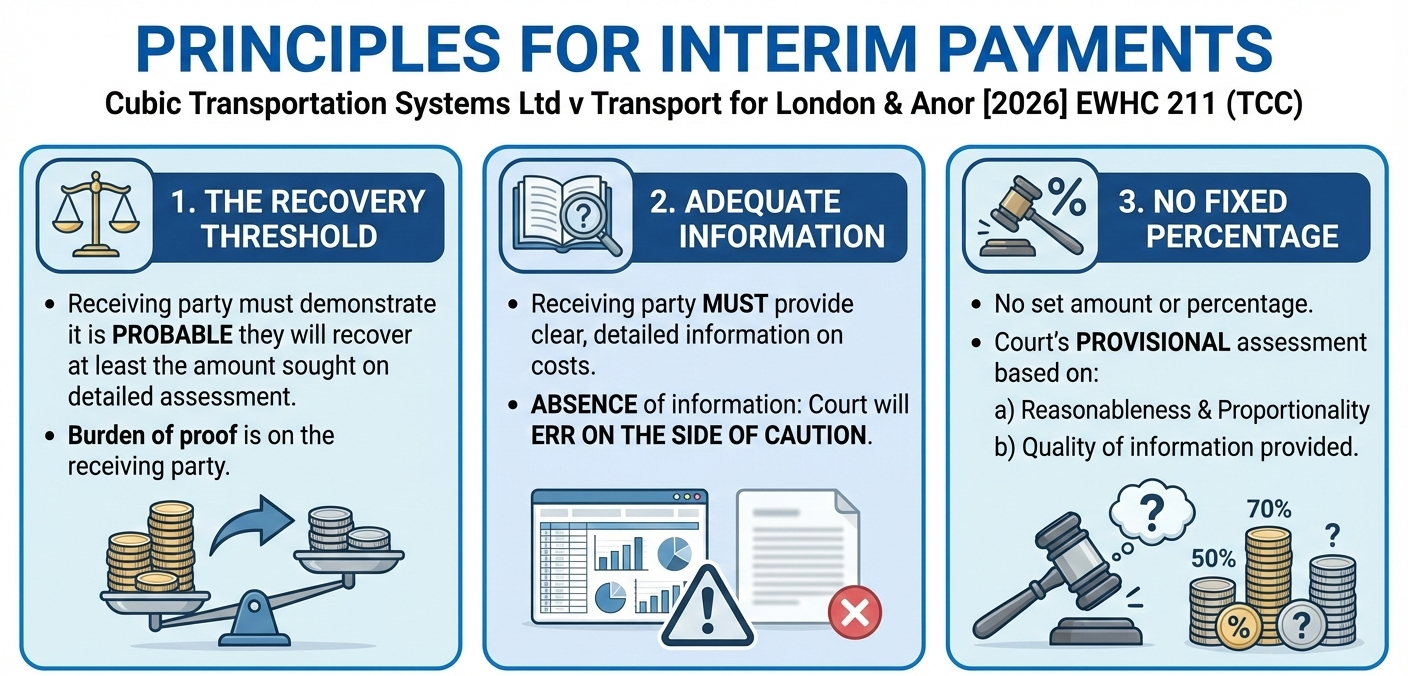
The key points arising from the decision are summarised in the graphic below.
The High Court applied the principles set out above and, in doing so, made the following specific observations:
“(1) The amounts in issue in these proceedings are substantial, concerning a procurement exercise in respect of a public project of very high value;
(2) Whilst there was only a one-day hearing, there was a very substantial volume of witness evidence and supporting documentation before the Court;
(3) CTSL's own costs are estimated to be £1,182,020.75;
(4) The importance and complexity of the applications can be easily demonstrated by the prestigious roll call of counsel recorded at the beginning of this judgment.”
Taken together, these observations demonstrate that the Court recognised the significance of the sums in issue, the extensive volume of evidence, the broadly comparable level of costs incurred by both parties, and the overall complexity and importance of the claim.
The court concluded that it would “have no doubt that on the detailed assessment TfL will recover at least £720,866.85” and accordingly ordered the interim payment sought.
Key Practice Points
The key takeaways for parties seeking an interim payment on account of costs are as follows:
Burden of proof
The onus lies on the receiving party to demonstrate that it will recover at least the amount sought by way of a payment on account. This reflects why cases with an approved or agreed Costs Budget often result in higher interim payments being ordered by the Court.Quality and sufficiency of information
The receiving party must provide adequate and reliable information to support the sum sought. Where there is a lack or absence of such information, the Court is likely to err on the side of caution. Careful preparation is therefore essential to maximising the level of any interim payment.No fixed formula
There is no prescribed percentage or standard figure for an interim payment on account. The appropriate amount will depend on the level of costs claimed, the Court’s provisional view of what is reasonable and proportionate, and the quality of the information placed before it.
Should you have any queries arising from this article or upon costs generally then please do not hesitate to get in touch with our friendly team either via phone 01482 534567 or e-mail info@carterburnett.co.uk